


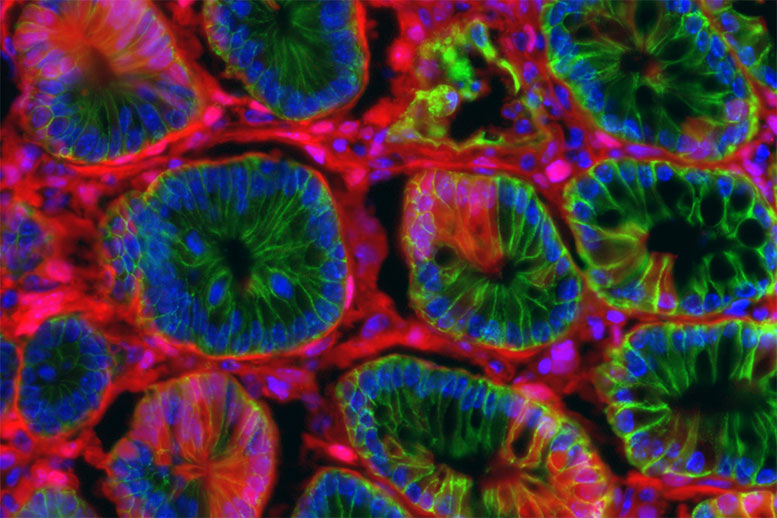
mit scientists have shown in mice that they are able to generate colon tumors that very carefully resemble human tumors via the use of the gene-editing gadget referred to as crispr. this advance have to help researchers learn more approximately how the ailment progresses and allow them to check new therapies.
as soon as shaped, lots of these experimental tumors spread to the liver, much like human colon cancers often do. these metastases are the maximum not unusual purpose of loss of life from colon cancer.
“that’s been a missing piece inside the look at of colon cancer. there's sincerely no dependable method for recapitulating the metastatic progression from a primary tumor within the colon to the liver,” says omer yilmaz, an mit assistant professor of biology, a member of mit’s koch institute for integrative cancer research, and the lead senior creator of the observe, which seems in nature biotechnology.
the examine builds on latest work by tyler jacks, the director of the koch institute, who has extensively utilized crispr to generate lung and liver tumors in mice.
“crispr-based technologies have started to revolutionize many components of cancer studies, together with building mouse models of the ailment with extra velocity and extra precision. this study is a good example of both,” says jacks, who is additionally an creator of the character biotechnology paper.
the paper’s lead authors are jatin roper, a research associate at the koch institute and a gastroenterologist at tufts clinical middle, and tuomas tammela, a research scientist at the koch institute.
mimicking human tumors
for decades, most cancers biologists have taken two wonderful processes to modeling cancer. one is to develop immortalized human cancer cells known as cancer mobile traces in a lab dish. “we’ve found out loads through reading these -dimensional cellular strains, but they've boundaries,” yilmaz says. “they don’t sincerely reproduce the complex in vivo environment of a tumor.”
some other extensively used approach is genetically engineering mice with mutations that predispose them to expand cancer. however, it can take years to breed such mice, particularly in the event that they have a couple of cancer-linked mutation.
currently, researchers have started the usage of crispr to generate cancer fashions. crispr, at the beginning determined via biologists reading the bacterial immune machine, includes a dna-slicing enzyme called cas9 and short rna guide strands that concentrate on precise sequences of the genome, telling cas9 where to make its cuts. using this system, scientists can make focused mutations in the genomes of residing animals, either deleting genes or placing new ones.
to set off most cancers mutations, the investigators bundle the genes for cas9 and the rna manual strand into viruses known as lentiviruses, which might be then injected into the goal organs of grownup mice.
yilmaz, who studies colon most cancers and how it's far stimulated with the aid of genes, food regimen, and growing old, decided to conform this approach to generate colon tumors in mice. he and contributors of his lab were already working on a method for developing miniature tissues referred to as organoids — 3-dimensional growths that, in this example, accurately mirror the structure of the colon.
inside the new paper, the researchers used crispr to introduce cancer-inflicting mutations into the organoids and then added them via colonoscopy to the colon, wherein they attached to the liner and shaped tumors.
“we had been capable of transplant these 3-d mini-intestinal tumors into the colon of recipient mice and recapitulate many elements of human sickness,” yilmaz says.
greater correct modeling
once the tumors are installed within the mice, the researchers can introduce extra mutations at any time, allowing them to have a look at the impact of each mutation on tumor initiation, progression, and metastasis.
nearly 30 years in the past, scientists found that colon tumors in humans typically collect cancerous mutations in a particular order, but they haven’t been capable of correctly model this in mice till now.
“in human patients, mutations in no way arise abruptly,” tammela says. “mutations are received through the years because the tumor progresses and turns into extra competitive, more invasive, and greater metastatic. now we are able to model this in mice.”
to demonstrate that capability, the mit crew brought organoids with a mutated form of the apc gene, that's the cancer-initiating mutation in 80 percentage of colon most cancers patients. as soon as the tumors have been mounted, they added a mutated form of kras, that is normally discovered in colon and plenty of other cancers.
the scientists also introduced components of the crispr device without delay into the colon wall to speedy version colon cancer with the aid of enhancing the apc gene. they then introduced crispr components to also edit the gene for p53, which is generally mutated in colon and other cancers.
“those new approaches lessen the timeframe to broaden genetically engineered mice from years to only a few months, and involve very fundamental gene engineering with crispr,” roper says. “we used p53 and kras to illustrate the principle that the crispr modifying technique and the organoid transplantation method may be used to right away model any feasible most cancers-associated gene.”
on this study, the researchers also showed that they may develop tumor cells from sufferers into organoids that would be transplanted into mice. this may deliver doctors a way to perform “customized medicine” wherein they take a look at numerous treatment alternatives towards a patient’s personal tumor cells.
fernando camargo, a professor of stem cellular and regenerative biology at harvard university, says the have a look at represents an vital enhance in colon most cancers studies.
“it lets in investigators to have a totally flexible version to look at a couple of factors of colorectal most cancers, from basic biology of the genes worried in development and metastasis, to testing ability capsules,” says camargo, who turned into now not concerned within the studies.
yilmaz’ lab is now using those techniques to examine how different factors such as metabolism, weight-reduction plan, and getting old have an effect on colon cancer development. the group is also the usage of this technique to test ability new colon most cancers drugs.
the research became funded by means of the howard hughes clinical institute, the national institutes of fitness, the branch of defense, the v basis v scholar award, the sidney kimmel student award, the pew-stewart believe student award, the koch institute frontier studies software via the kathy and curt marble cancer research fund, the yank federation of growing old studies, and the desire price range for most cancers research.
0 comments:
Post a Comment